
Installing edge-of-field conservation practices to control erosion and nutrient runoff from farm fields may seem like a no-brainer when it comes to what a farmer can do to help improve local water quality, but farmers’ adoption of these practices remains slow. This has a lot of conservation professionals pondering how they can better sell these practices to farmers.
A reason for the slow adoption rates could be limited understanding of edge-of-field practices, in terms of what they are, what they cost, and how they can benefit a farm, as a study by Iowa State University researchers found.
Who better to help increase farmers’ understanding of these practices than farmers who have implemented them on their own operations?
Supporting farmer-to-farmer learning about edge-of-field practices was an objective of the Good Idea Mini-grant program, which awarded funds to seven teams of farmers and farm advisors to install edge-of-field practices on the farmers’ operation and produce a video or podcast about their experience to help inspire other farmers to consider the practice. When their projects were complete, we asked the mini-grant teams what they think works to sell these practices to other farmers.
Here are three themes from their responses that could aid conservation professionals’ outreach to farmers about edge-of-field practices.
Talk About Keeping Farmland Productive
Farmers generally care about the productivity of their land and operation, so leading with productivity could be a productive entry point. To mini-grant recipient Matthew Oehmichen, whose family owns a farm in Wisconsin and Short Lane Ag Supply, edge-of-field practices are about maximizing every acre on your farm.
“You’re keeping your farmland in productivity,” he said, even if what it’s producing is not cash crops.
Several of the mini-grant recipients installed edge-of-field practices on marginal acres, or farmland on which they were losing profit. For example, Oehmichen’s team transformed underperforming cropland on his family’s farm, which included a swath of invasive reed canary grass, into three different filter strips – a harvestable perennial hay buffer, a pollinator planting, and a wildlife enhancement strip.
He stressed this transformation will help them build their margins by eliminating fields with negative yields.
“It’s about analyzing the best parts of the farm and how do you farm those economically,” said Oehmichen, who used yield maps to analyze where they were losing yield.
Another mini-grant recipient, Wisconsin farmer Dennis Mitchell, installed a field buffer where his field meets the edge of a creek, a strip of land that was producing low yields due to wildlife damage and shade from the adjacent tree line, which also made the field harder to manage. He calls the project a “win-win” for conservation and the farm.
“Because you’re spending just as much money on that edge piece as you are in the middle of the field, but your production is less. So, for us, it’s a benefit money wise,” said Mitchell.
Highlight the Additional Stewardship Benefits
Over the years, many studies have pointed out that most farmers are intrinsically motivated to steward their land, and this stewardship ethic can motivate their willingness to adopt conservation practices. This is good news for edge-of-field practices, since reducing soil erosion and nutrient loss aren’t their only stewardship-related selling points.
Oehmichen and his team emphasized how their project improved habitat for not just pollinators, but also deer. In a state like Wisconsin, which has a thriving hunting culture, this can be an attractive perk.
“The value may not be dollars and cents, but there’s a lot of value in creating this kind of habitat on your farm,” said Scott Stipetich of Pheasants Forever, one of the farm advisors on Oehmichen’s mini-grant team.
Edge-of-field practices may also help deter wildlife from eating crops, as Mitchell is finding with his field buffer. Not only are his crops experiencing less damage from wildlife, but it has also been easier to work the field because they no longer have to contend with an unwieldy tree line.
Connect Them with Farmers Who Have Already Done It
Farmers respond well to honest and relatable stories from their peers. They want to hear about the successes and, especially, the mistakes or failures.
So, perhaps a good early step to help a farmer decide if an edge-of-field practice is right for them is to connect them with another farmer who has been there and done that.
“Look at some [buffer strips] that have been done. Then you get a good idea of what people went through to do it,” said Mitchell.
Being able to see a practice in real life and understand how another farmer made it work could be especially important to farmers who are more risk averse and want physical proof that a practice will make a difference.
Through Good Idea Mini-grants, there are now at least seven more edge-of-field practices on the Midwestern landscape that can serve as demonstration sites for other farmers seeking to enhance the value of their land.
“There are more and more places to point a finger to and say, ‘look, these people are doing it, and you can try it too’,” said Oehmichen.
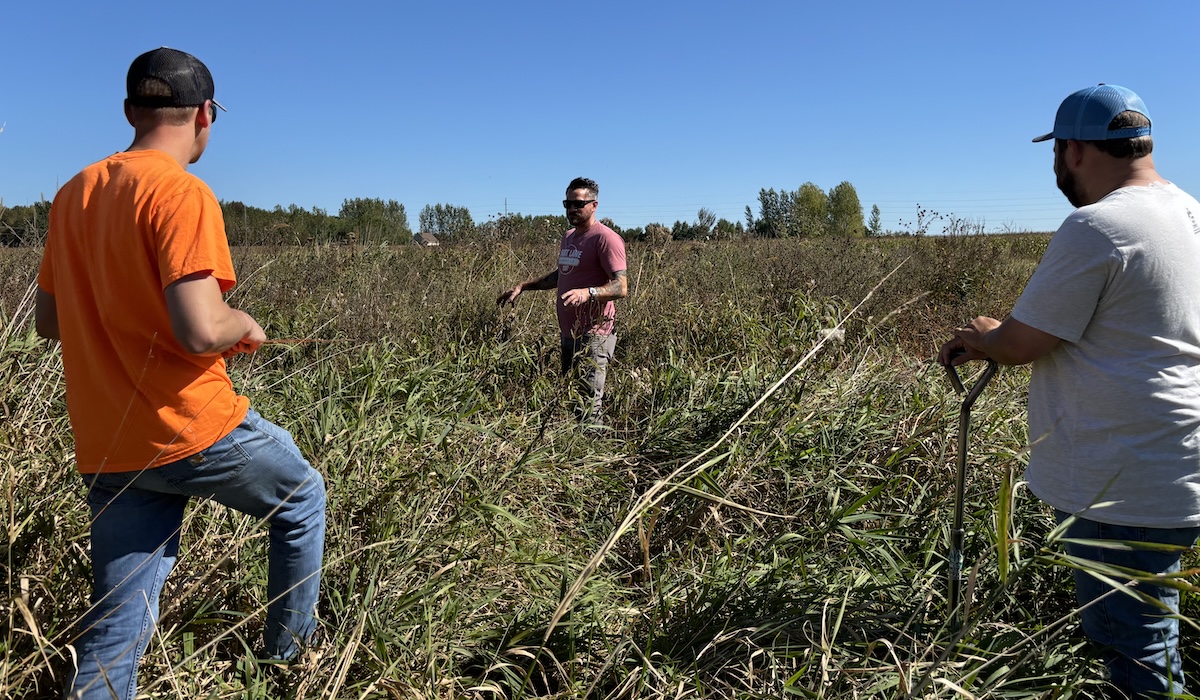
Header photo: From left to right, Scott Stipetich, Matthew Oehmichen, and Caleb Armstrong stand in the pollinator planting they installed on the Oehmichen family farm. Photo by Jenny Seifert.


